
Category:
Setting the Lens
There is a sacred moment in practice when everything softens.
Not because it becomes easier.
But because your attention becomes steadier.
The connection between breath and the Subtle Body is profound.
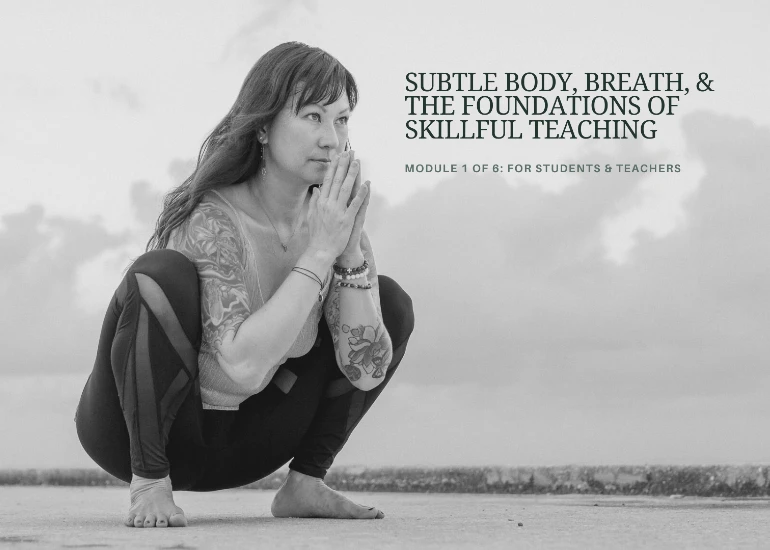
Module One of the 300-hour training begins here.
Not with sequencing.
Not with cueing.
Not with performance.
It begins with orientation.
Where is your attention resting?
How are you inhabiting your body?
What is organizing your breath?
We speak often about “the subtle body,” and sometimes that phrase can feel abstract or mystical. But what we are exploring in this first intensive is far more intimate and grounded than that.
The subtle body is the lived internal field of experience — breath, sensation, tone, perception, attention. It is how practice feels from the inside.
It is the quiet pulse of your inhale.
The shifting of emotional tone mid-sequence.
The moment you notice tension gathering in your jaw.
The difference between pushing and participating.
Breath sits at the center of this exploration.
Not as a technique to control.
But as an organizing force.
Breath reveals orientation.
Breath reveals state.
Breath reveals coherence — or the lack of it.
We study breath not only experientially, but anatomically — how it moves through fascial relationships, how it shapes tone, how it influences clarity. When the breath is steady, perception steadies. When attention steadies, choice becomes more skillful.
This is where the foundations of skillful teaching begin.
Not in what you say.
But in how you see.
For those who are not teaching, this work offers a deeper way of inhabiting your own practice — refining attention, recognizing subtle shifts, cultivating steadiness and ease.
For those who are teaching (or preparing to), this intensive assumes you already know how to structure a class. Instead, we begin exploring how presence shapes response. How timing matters. How awareness influences what arises next.
We unpack the koshas as a framework for discernment — recognizing whether attention is operating at the level of physical effort, breath rhythm, emotional tone, mental focus, or perceptual clarity.
We revisit bandhas not as muscular locks to apply, but as reflections of internal organization — how breath, awareness, and tone gather around a stable center.
This intensive is not about adding more information.
It is about settling the lens.
Learning to notice more clearly.
Listening more carefully.
Remaining grounded as practice unfolds.
And in doing so, we begin cultivating something essential: a growth mindset rooted not in striving, but in responsiveness.
Growth requires awareness.
Awareness requires steadiness.
Steadiness requires breath.
Module One lays the perceptual foundation for everything that follows — anatomy, assessment, application. Without this lens, technique becomes mechanical. With it, teaching and practice become intelligent, adaptive, and alive.
If you feel called to refine how you see —
to inhabit practice from the inside out —
to build foundations that will support long-term clarity and skill —
Module One begins soon.
Because this training unfolds in a rotating modular format, the next opportunity to take Module One will not be until February 2027.
With steadiness and curiosity,
Jade
P.S. If you’ve been curious about the 300-hour path but unsure where to begin, this is where the work truly starts.

