Category:
Understanding the Kośas (Koshas) and the Subtle Body
When we talk about the subtle body, it can feel abstract — almost mystical.
But the koshas offer something remarkably grounded: a map.
This map comes from the Taittirīya Upanishad, an early Vedantic text that describes the human being not as a single fixed identity, but as a layered experience.
The Sanskrit word kosha means “sheath” — something that covers or encases.
Imagine nested layers.
Not stacked hierarchically — but interwoven.
Each influencing the others.
1. Annamaya Kośa — The Physical Sheath
Anna means food.
This is the “food body” — the tangible structure built from what we consume.
Muscle. Bone. Fascia. Organs.
The body we stretch and strengthen in asana.
Most modern yoga begins here — with biomechanics, alignment, intelligent load.
And this layer matters deeply.
Without a stable foundation, the subtler layers become harder to perceive.
But if we stop here, yoga becomes exercise.
The kosha model reminds us: the body is the doorway — not the destination.
2. Prāṇamaya Kośa — The Energetic Sheath
Beyond structure is movement.
Not movement of limbs — but movement of life force.
This is the layer of prāṇa, carried through breath and subtle energetic channels.
When breath steadies, attention steadies.
You’ve likely felt this in practice — the moment when effort organizes itself around respiration.
When transitions soften.
When strain becomes rhythm.
Breath is not just oxygen exchange.
It is the bridge between gross and subtle.
This is why in Module One we place breath at the center of everything.
3. Manomaya Kośa — The Mental-Emotional Sheath
Here lives interpretation.
The story that says, “I’m behind.”
The thought that says, “I should be stronger.”
The emotional residue we carry onto the mat.
This layer influences how we experience physical sensation.
Two students can hold the same posture.
One experiences expansion.
The other experiences threat.
The difference often lives here.
Understanding this layer changes how we teach.
It shifts us from correcting shapes to supporting nervous systems.
4. Vijñānamaya Kośa — The Wisdom Sheath
This is discernment.
The capacity to witness thought without becoming entangled in it.
The space between stimulus and response.
Growth mindset lives here.
Not forced positivity.
Not bypassing discomfort.
But the ability to say, “This is hard — and I can stay present.”
Skillful teaching is rooted in this layer.
Without it, instruction becomes rigid or reactive.
With it, guidance becomes responsive and intelligent.
5. Ānandamaya Kośa — The Bliss Sheath
This layer is often misunderstood.
It is not euphoria.
Not constant joy.
It is a quiet undercurrent of steadiness.
A subtle sense of “enoughness” beneath effort.
Sometimes it flickers in savasana.
Sometimes it appears in the middle of something challenging.
It is not something we create.
It is something we uncover when the outer layers settle.
Why the Kośas (Koshas) Matter for Teachers
The koshas are not just philosophy.
They are a diagnostic lens.
When a student struggles, we can ask:
- Is this physical fatigue?
- Is breath dysregulated?
- Is the mind reactive?
- Is discernment unclear?
Teaching from this layered awareness changes everything.
It builds nuance.
It cultivates humility.
It supports long-term growth rather than short-term performance.
A Living Inquiry
The koshas are not something to master.
They are something to observe.
In your next practice, you might quietly ask:
Which layer is most present right now?
Where am I over-efforting?
Where am I disconnected?
The answers shift daily.
That is the beauty of it.
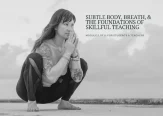
Module One of the 300hr Advanced Training is devoted to this foundation — subtle body, breath, and the architecture of skillful teaching.
We don’t just study the koshas conceptually.
We experience them — through sequencing, breathwork, observation, and refined dialogue.
With steadiness and curiosity,
Jade
P.S. If you’ve been curious about the 300-hour path but unsure where to begin, this is where the work truly starts.