Category:
Prāṇamaya Kośa (Kosha)
There are moments when you suddenly realize you haven’t been breathing fully.
Not because you chose to hold your breath—
but because life quietly asked your body to brace.
Your chest tightens.
Your shoulders lift and stay there.
Your ribs barely move.
And you keep moving through the day like that.
Answering messages.
Making decisions.
Holding space for others.
Until something small happens.
You pause.
You step outside.
You sit down for practice.
And a deeper breath arrives.
Sometimes it feels like relief.
Sometimes it feels like emotion rising.
Sometimes it feels like the body remembering something it had forgotten.
That moment matters.
Because breath is not just air moving through the lungs.
It is how the body organizes itself around experience.
The Layer of Breath
In yoga philosophy, this layer of experience is called Prāṇamaya Kośa—the sheath of vitality.
It lives just beneath the physical body.
Not something you can see,
but something you can absolutely feel.
It’s the way your breath changes when you’re under pressure.
The way your belly softens when you finally feel safe.
The way your entire system exhales when something difficult passes.
Your breath carries your history.
It remembers urgency.
It remembers protection.
It remembers when you had to hold everything together.
And it also remembers how to soften.
If we give it the space.
Breath in Real Life
I see this not only in practice, but in everyday life.
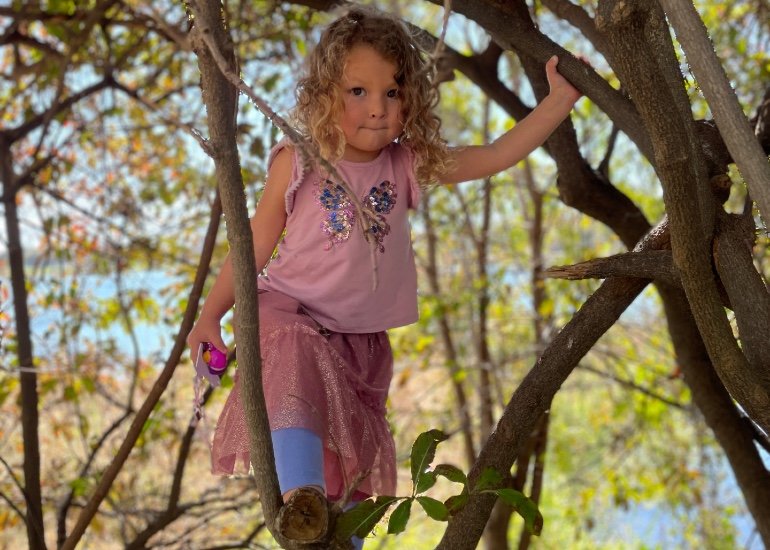
My daughter has loved climbing trees since she was very young. I’ve had many moments where she’s high up on a branch, completely at ease, while other parents stand nearby watching her… and watching me… watching her.
There’s often a kind of collective tension in the air.
But I’ve learned something through years of practice:
If my nervous system spikes, she feels it immediately.
If I tense up, she tenses up.
If my breath becomes sharp, hers does too.
And when that happens, we both lose something important—steadiness.
So I stay calm.
Not careless.
Not disengaged.
Just grounded.
Like a seed nestled quietly into the earth.
When my breath stays steady, hers stays steady too.
And that steadiness allows her to move with awareness rather than fear.
This is Prāṇamaya Kośa in real life.
Not philosophy.
Relationship.

Listening for the Breath
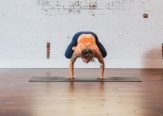
I see the same thing happen in the yoga room.
Sometimes a student moves into a very intense posture.
Their body is capable.
Their strength is there.
But the moment the breath changes—becomes strained, uneven, or disappears—we come out.
Immediately.
Not because the posture is wrong.
But because something deeper has shifted.
You can often sense it before anything else.
The ribs stop expanding.
The throat tightens.
The body begins to brace.
The shape may still be there,
but the system is no longer working with itself.
The breath tells the truth long before the posture does.
Where This Work Begins
This is why we begin here.
In the first module of the SJY 300-hour Advanced Yoga Training, we explore the subtle body and the role of breath—not as a technique to master, but as something to become deeply familiar with.
Before anatomy.
Before sequencing.
Before adjustments.
We begin by learning how to feel.
Because if you cannot sense when your own breath becomes tight,
how will you recognize it in someone else?
If you do not understand your own thresholds,
how will you guide students without pushing past theirs?
Breath teaches us how to listen.
And that kind of listening changes everything.
Living Inside the Breath
The breath that steadies you in a posture
is the same breath that steadies you in a difficult moment.
The breath that softens your ribs
is the same breath that softens your voice.
This is not just something we practice on the mat.
This is how we move through our lives.
Where in your life are you holding your breath?

If something in this reflection feels familiar —
the holding, the bracing, the moment when a full breath finally returns —
then you already understand why this work matters.
This is the work we explore together in the 300hr.
Not to become more impressive.
Not to collect techniques.
But to become more honest in how we inhabit our bodies,
how we guide others,
and how we move through the world.
Over the years I’ve come to see that if we don’t understand our own breath, everything else we build as teachers rests on unstable ground.
So we begin there.
With listening.
With patience.
With breath.
And if you feel even the smallest curiosity about walking that path more deeply, I would love to share that space with you.
Not ahead of you.
Not above you.
Alongside you.
Begin with breath.
What changes when you allow yourself to exhale?
Love & Light,
Jade Skinner
P.S. In the 300-hour Advanced Teacher Training, this layer of practice appears early in the journey. In Module One — Subtle Body, Breath & the Foundations of Skillful Teaching, we begin exploring how the breath, nervous system, and subtle body influence not only our physical practice, but also the way the mind interprets experience.